Key Takeaways
A maritime digital twin is a live digital replica of a ship, port, offshore platform, or marine system. It connects the physical and digital worlds by using real time data from sensors, software systems, and external feeds to monitor performance, simulate different scenarios, and improve decisions across the ship’s lifecycle.
Semvar is an AI-powered digital twin platform for IoT used across smart ships, ports, offshore operations, smart buildings, and mining. In maritime operations, platforms like Semvar unify fragmented data collection from vessels, ports, SCADA systems, AIS, weather feeds, and onboard equipment into one operational digital twin model.
A maritime digital twin is a high-fidelity digital model of a ship, port, or wider marine environment that updates in real time using sensor data, enabling monitoring, simulation, and optimisation across the asset’s lifecycle.
What you will learn:
Digital twin technology can improve fuel consumption, maintenance, safety, compliance, and fleet management.
Industry benchmarks show 5–15% fuel and emissions savings on voyage optimisation, 30–50% reductions in unplanned downtime, and 15–20% maintenance budget reductions in well-scoped deployments.
Digital twins enable predictive maintenance by continuously monitoring performance data and applying advanced algorithms to forecast potential equipment failures, recommend maintenance schedules, and optimise spare parts inventory.
AI systems can integrate seamlessly within digital twin environments, enhancing the analysis of vast data generated by these models to improve vessel and fleet ROI.
This article covers definitions, architecture, use cases, ROI, key challenges, and future trends in digital twin maritime adoption.
What Is a Maritime Digital Twin? (Definition & Scope)
A maritime digital twin is a high-fidelity digital model of a ship, port, or wider marine environment that updates in real time using sensor data, enabling monitoring, simulation, and optimisation across the asset’s lifecycle. More broadly, a digital twin is a high-fidelity duplication of a physical entity that simulates a dynamic real-world environment, continuously updated with real-world data from sensors and software components.
A useful distinction is this: a static 3D model is mainly visual, a digital shadow receives one-way live data from the asset, and a true digital twin has bi-directional synchronization with control loops. In practice, this means the virtual model does not only reflect the physical ship; it can also support decision support, recommend interventions, and influence operational systems when approved by crew members or shore teams.
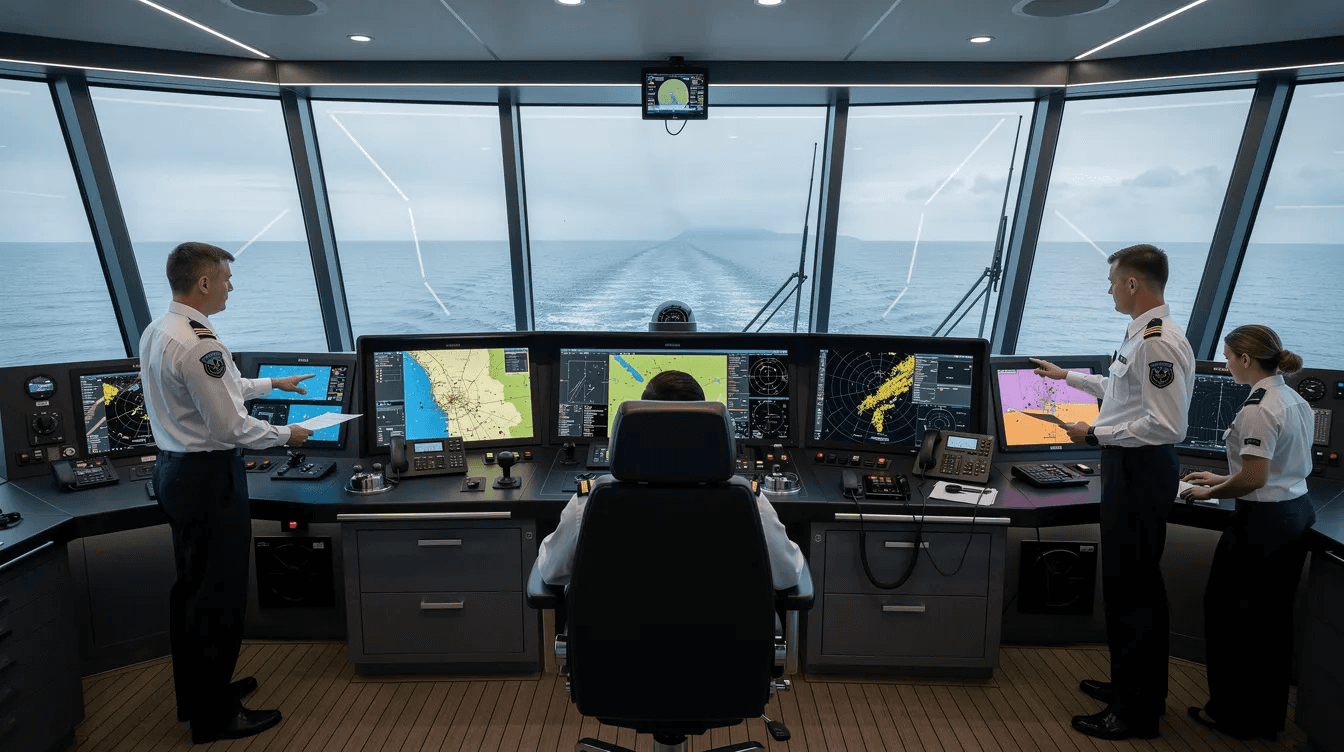
In maritime operations, digital twin models can include the hull, propulsion system, auxiliary engines, cargo systems, navigation systems, power systems, and environmental context such as waves, weather, currents, and marine environment conditions. Some digital twins also include commercial signals such as route schedules, bunker prices, port congestion, and charter-party constraints.
Digital twins operate at several scales:
A single smart ship, where sensors continuously collect engine, navigation, structural, and fuel data.
A fleet, where shipping companies compare vessels, detect outliers, and improve fleet management.
A port, harbor, or coastal region, where digital replicas of terminals, waterways, tides, and traffic flows support coordinated planning.
For Semvar, this scope matters because maritime assets rarely exist in one clean system. Semvar ingests heterogeneous IoT data such as engine telemetry, AIS, radar, LiDAR, port SCADA, meteorological feeds, and maintenance records, then turns that digital information into a coherent digital representation in a shared virtual space.
From NASA to Smart Ships: Evolution of Digital Twin Technology
The core idea behind digital twin technology is older than the term itself. NASA used physical “twins” and simulations during the Apollo era in the 1960s and 1970s to understand spacecraft behavior under extreme conditions. The term digital twin is widely associated with Dr. Michael Grieves, who introduced the concept in 2002 in the context of product lifecycle management.
The first large-scale industrial deployments appeared in aerospace and manufacturing around 2010. By 2015–2020, cheaper sensors, cloud computing, IoT connectivity, and machine learning made digital twin platforms more practical for the shipping industry. The maritime sector had long used simulation in ship design, but the shift toward real time monitoring changed the role of the digital model from a design aid into an operational tool.
In the maritime industry, early applications appeared in naval engineering, ship designers’ simulation workflows, and condition monitoring. From 2017 to 2023, the rise of smart ship programs and Maritime Autonomous Surface Ships (MASS) pushed new concepts into commercial trials, including autonomous ferry deployments in Finland and Norway that used digital twins for simulation, mission planning, and control validation.
Semvar sits in this evolution as a cloud-native, AI-first digital twin platform for complex, sensor-rich environments. Our role is to make the same technology usable for physical vessels, offshore assets, ports, and other industrial IoT systems without forcing operators to rebuild every legacy workflow from scratch.
Digital Twin Architecture for Ships, Fleets, and Ports
Effective maritime digital twins follow a layered architecture. The names vary across a comprehensive literature review, class guidance, and vendor designs, but the practical pattern is consistent: collect data, model the asset, apply intelligence, and deliver useful workflows to humans and systems.
1. Data Layer
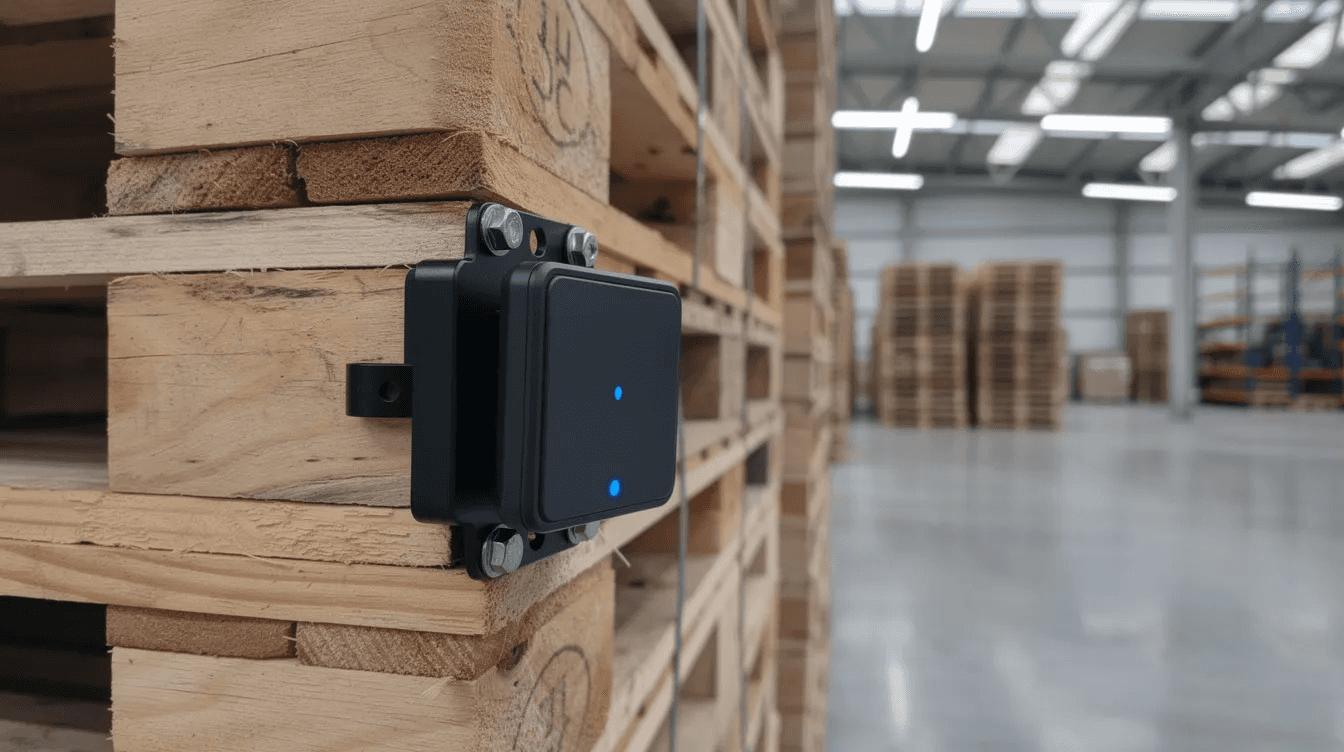
The data layer handles data collection from onboard, shoreside, and external sources. Continuous IoT sensor integration gathers data on engine load, fuel usage, structural vibrations, and fluid temperatures for digital twins. It may also process data from engine RPM, fuel flow meters, vibration sensors, hull stress gauges, AIS, ECDIS, radar, LiDAR, weather forecasts, ocean models, crane telemetry, and port energy systems.
Common maritime and industrial protocols include:
MODBUS
OPC UA
NMEA 2000
MQTT
REST APIs and streaming interfaces
Limited connectivity at sea means the sensor suite cannot depend only on cloud links. Edge gateways onboard a vessel filter, compress, buffer, and validate live data before sending it to shore.
2. Model & Simulation Layer
The model layer combines physics-based models with data-driven models. Hydrodynamics can estimate resistance in different sea states, while power-system models simulate load distribution across generators, batteries, and shaft lines. Machine learning algorithms add pattern recognition from historical data, such as how hull fouling changes fuel consumption over time.
For example, the same virtual representation can test fuel consumption at different drafts, trim settings, weather windows, and speeds. Digital twins allow for risk-free scenario modelling, enabling operators to test “what-if” scenarios without real-world risks.
3. Intelligence Layer
The intelligence layer applies artificial intelligence, predictive analytics, and machine learning to locate anomalies, predict failures, and optimise outcomes. The integration of AI and IoT technologies with digital twins allows for real-time monitoring and predictive analytics, which can significantly enhance operational efficiency in maritime applications.
This is where a vessel’s condition becomes actionable. AI can detect abnormal bearing temperatures, unusual fuel curves, vibration drift, or inefficient engine loading. The integration of digital twins with AI technologies enhances predictive maintenance capabilities by analysing vast amounts of data to locate specific patterns and generate insights that improve operational efficiency.
4. Experience & Integration Layer
The experience layer is where decision makers, crew members, and operations teams interact with the twin. It includes dashboards, alerts, reports, APIs, virtual reality interfaces, and integrations with PMS, CMMS, ERP, voyage planning, and port community systems.
Semvar exposes APIs and low-code tools so teams can build custom maritime workflows. This matters because operational value is not created by vast amounts of raw data; it is created when the right user receives a clear recommendation at the right time.
Core Use Cases of Digital Twins in Maritime Operations
Digital twin technology now spans the full maritime lifecycle: ship design, construction, voyage execution, maintenance, decarbonisation, compliance, training, and decommissioning. In today’s maritime industry, digital twins provide a proactive approach to problems that were historically managed through manual inspection, periodic reports, and delayed analysis.
Fuel and Route Optimisation
A digital twin can evaluate different scenarios for speed, route, trim, weather exposure, draft, and arrival time. By combining real time data with forecasts for wind, waves, and currents, operators can reduce fuel consumption and emissions without compromising safety or contractual obligations.
Industry benchmarks commonly show 5–15% fuel and emissions savings for long-haul route optimisation. In port-linked scenarios, the benefit can be even larger. A Busan port digital twin study found that coordinated scheduling between ships, terminals, and tugs every five minutes could reduce CO₂ emissions by more than 75% in a mid-term delay scenario by avoiding unnecessary waiting and idling.
Predictive Maintenance
Digital twins enable predictive maintenance by continuously monitoring performance data and applying advanced algorithms to forecast potential equipment failures, recommend maintenance schedules, and optimise spare parts inventory. By continuously monitoring performance data and applying advanced algorithms, digital twins can forecast potential equipment failures, recommend maintenance schedules, and optimise spare parts inventory, thus minimising downtime and reducing maintenance costs.
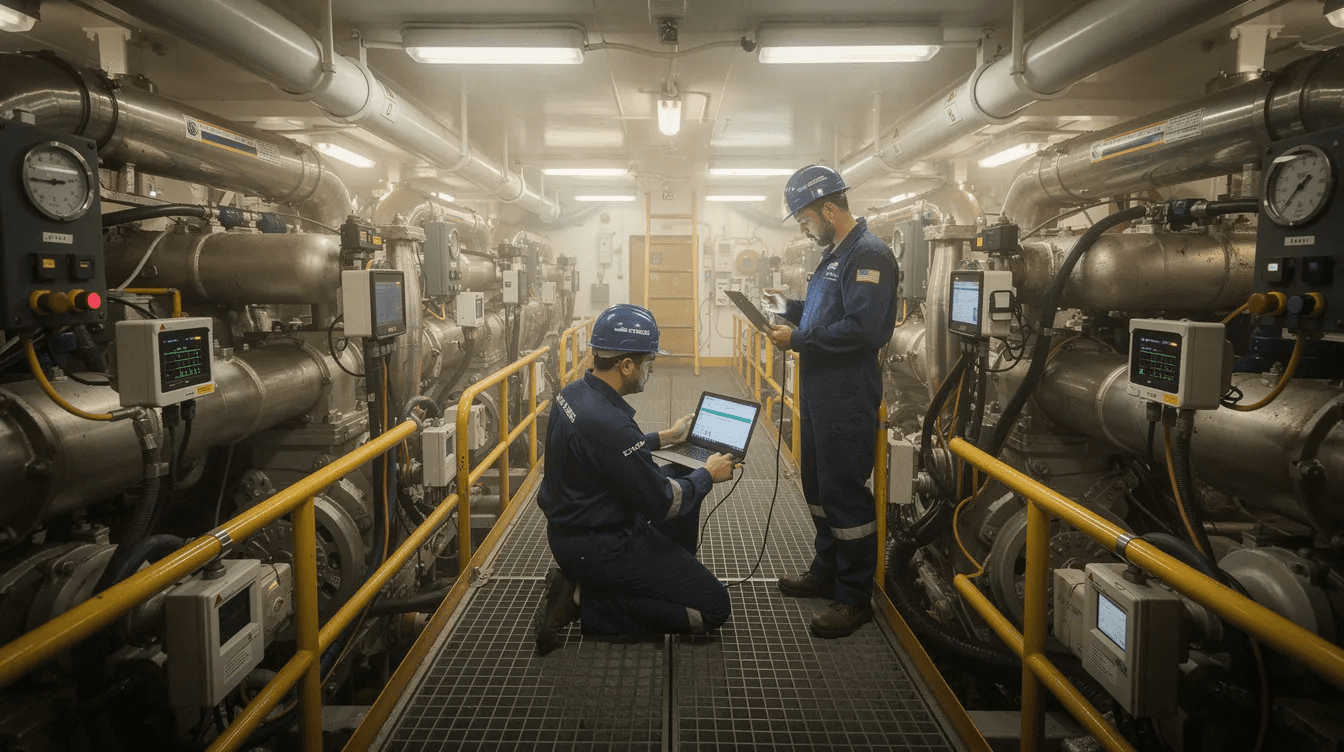
By utilising digital twins, maritime operators can identify potential issues before they escalate, ensuring that repairs are scheduled and performed without interrupting the vessel’s operations, thus reducing downtime and operational costs. Predictive maintenance commonly uses vibration, temperature, pressure, oil quality, fuel flow, and load data from critical components such as main engines, generators, thrusters, pumps, and compressors.
Public case studies show unplanned downtime reductions of 30–50% in fleet settings, while focused component monitoring has saved more than USD 80,000 per vessel in avoided wear-related repair costs. Semvar supports this with pre-built anomaly detection and remaining useful life models that can be tuned to a specific engine type, operating profile, and maintenance history.
Port and Terminal Operations
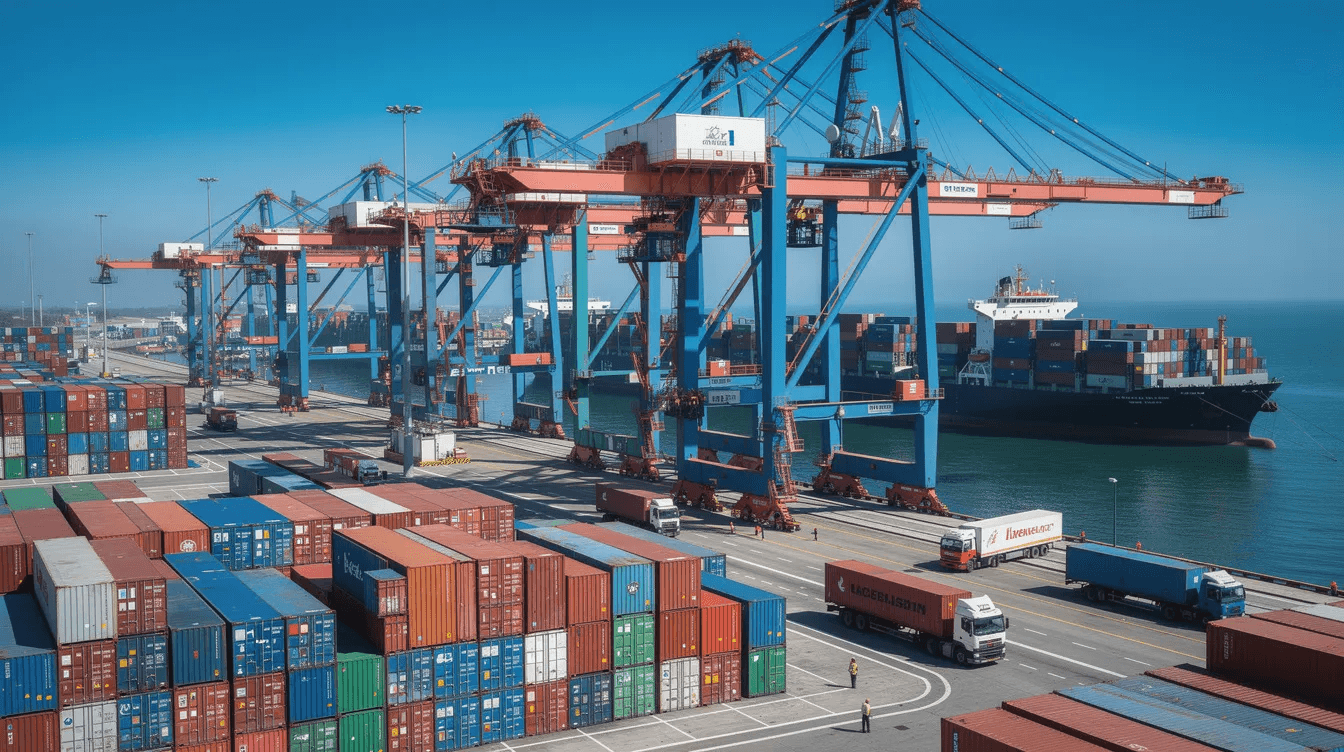
Port digital twins connect berth occupancy, AIS, tug availability, crane status, yard equipment, truck gates, and energy consumption. This allows operators to simulate berth allocation, crane scheduling, yard planning, and landside congestion before changes are made in the real world.
Smart port operations make use of digital replicas to simulate water flows and optimise container volumes before physical implementations. Digital twins can optimise port efficiency by managing truck routes and crane movements to reduce turnaround times and congestion.
Safety, Training, and Remote Operations
Digital twins provide real-time insights into a vessel’s condition, performance, and fuel efficiency, enabling stakeholders to monitor and optimise operations effectively. Enhanced safety features in digital twins provide real-time hazard prediction and collision avoidance.
Safety teams can simulate heavy weather, machinery failures, loss of propulsion, cargo incidents, or collision avoidance maneuvers inside a realistic environment. Digital twins enhance crew training by providing a virtual environment for familiarization with vessel operations, significantly reducing onboarding time and improving overall safety. End-to-end visualisations in digital twins render comprehensive 3D environments of ships, subsea topography, and port infrastructure.
Decarbonisation and Compliance
Digital twin technology supports regulatory readiness for compliance with environmental standards such as IMO and EU ETS decarbonisation rules. Operators can track EEXI, CII, EU ETS exposure, fuel use, emissions intensity, and voyage-level carbon performance in real time.
Digital twin technology optimizes performance and predicts future outcomes in maritime operations. It also helps evaluate retrofits such as hull coatings, propeller upgrades, wind-assist rotors, shore power, LNG conversions, methanol systems, battery hybrids, and waste-heat recovery before significant investment is committed.
Semvar supports these use cases through:
Pre-built maritime AI models for anomaly detection, predictive maintenance, and fuel-efficiency benchmarking.
Fleet-wide KPI dashboards for emissions, utilisation, fuel consumption, and compliance risk.
APIs that connect with voyage planning, PMS/CMMS, ERP, and port systems.
Hybrid edge-cloud deployment for remote monitoring when vessels operate beyond reliable bandwidth.
AI-Enhanced Maritime Digital Twins: From Monitoring to Autonomy
Digital twins become truly powerful when combined with artificial intelligence that can interpret patterns, recommend action, and automate narrow operational tasks. Digital twins, when combined with AI and IoT, can provide advanced decision support and automation capabilities, leading to safer and more efficient maritime operations.
Anomaly detection is often the first high-value AI use case. Supervised and unsupervised machine learning can identify abnormal fuel curves, bearing temperature spikes, unusual maneuvering, rising vibration, cooling-water drift, or deviations from normal generator load behavior. Alerts can be pushed to onboard engineers and shore-based technical teams in real time.
Predictive maintenance models go further by using time-series forecasting and physics-informed machine learning for engines, generators, thrusters, pumps, and cargo-handling systems. These models estimate remaining useful life, suggest root cause hypotheses, and recommend actions that align with maintenance schedules and spare-parts availability.
Decision support adds optimisation. Reinforcement learning or mathematical optimisation can propose speed changes, engine load balancing, battery dispatch, trim adjustments, and just-in-time arrival strategies. For MASS and remotely operated vessels, digital twins in the maritime industry allow stakeholders to visualize and analyse a ship’s performance and behavior in a virtual environment, optimising operations and predicting maintenance requirements.
The International Maritime Organization has described MASS autonomy in levels ranging from ships with automated processes and crew onboard to fully autonomous vessels. The future of Digital Twin technology in the maritime sector is expected to include advancements in automation, with fully autonomous ships being developed that rely on real-time data and predictive analytics for navigation and operations.
Semvar’s focus is decision support and supervisory control, not replacing crews. For safety-critical maritime operations, explainability matters. A recommendation should show why it was generated, what data influenced it, what uncertainty remains, and how it affects safety, cost, emissions, and compliance.
Lifecycle Applications: From Design to Decommissioning
A maritime digital twin should follow the asset from concept design through construction, operations, refit, and end-of-life decisions. In the design phase, ship designers can use simulation-led workflows to test hull forms, machinery layouts, electrical systems, stability assumptions, and control strategies before steel is cut.
During operations and maintenance, the same digital representation evolves into an operational twin connected to the physical ship. It receives live data from the sensor suite, compares performance against expected behavior, and supports alarms, diagnostics, benchmarking, and optimisation.
During refit and retrofit planning, digital twin models help compare LNG conversions, hybrid battery systems, wind-assist technology, shore power, carbon-capture concepts, and alternative fuels under realistic load profiles. Instead of relying only on averages, operators can test changes against actual routes, cargo profiles, hotel loads, sea states, and port calls.
For decommissioning and recycling, the digital twin can maintain a record of materials, hazardous substances, modifications, inspections, and equipment changes. That traceability supports safer recycling, compliance reporting, and port asset renewal.
Semvar manages versioning and configuration across lifecycle stages so teams know which model, equipment configuration, and assumptions were used for each decision.
Port, Coastal, and Ocean-Scale Digital Twins
Digital twins are not limited to vessels. Port authorities, hydrographic offices, governments, and offshore operators are building larger digital worlds that represent terminals, coastlines, subsea infrastructure, shipping corridors, and ocean regions.
A port digital twin can integrate berth plans, AIS tracks, crane telemetry, yard equipment, gate movements, tug schedules, power demand, and emissions. The result is a virtual model that helps reduce vessel waiting time, improve arrival punctuality, lower energy use, and coordinate decisions between ships and terminals.
Coastal and ocean twins combine bathymetry, tidal data, seabed composition, weather, waves, currents, traffic, and environmental monitoring. These systems support navigation safety, offshore wind planning, fisheries, subsea inspection, and environmental protection.
Green shipping corridors are another emerging use case. Route-level digital replicas can model fuel demand, bunkering locations, renewable energy supply, port readiness, vessel compatibility, and emissions reduction strategies across a specific corridor.
A platform like Semvar can host multi-scale twins: a physical vessel, the fleet it belongs to, the port it calls at, and the corridor it operates within. That shared operational view is essential for transforming maritime operations from isolated optimisation into coordinated ecosystem performance.
Challenges, ROI, and Implementation Roadmap
The implementation of Digital Twin technology in the maritime sector faces challenges such as the lack of necessary infrastructure and the need for specialized skills among stakeholders. The transition from traditional manual systems to Digital Twin technology is often met with reluctance from stakeholders accustomed to long-used hardware platforms, hindering adoption.
Technical challenges include old vessels with missing sensors, noisy instrumentation, inconsistent timestamps, fragmented legacy systems, and intermittent satellite communications. Limited connectivity at sea poses a significant challenge for the real-time data transmission required for effective Digital Twin operations in maritime settings. This is why edge computing onboard is not optional for serious deployments.
Data security and privacy concerns arise from the extensive data collection and processing involved in Digital Twin technology, complicating its implementation in the maritime industry. Data ownership between owners, charterers, ports, OEMs, and service providers needs to be clear. Secure architecture should include encryption, identity management, role-based access, audit logs, and alignment with IMO and class cyber guidance.
The commercial case is strongest when the first deployment is tied to a measurable operational problem. Typical ranges include:
5–15% fuel and emissions improvement for voyage, trim, or fleet optimisation.
30–50% reduction in unplanned downtime through predictive maintenance.
15–20% maintenance budget reduction in mature asset-integrity programs.
6–18 month payback for focused vessel or terminal pilots, with broader fleet or port programs often planned over 12–36 months.
A practical roadmap looks like this:
Discovery and data audit: inventory sensors, systems, data quality, connectivity, and pain points.
Pilot twin: choose one vessel, one equipment class, or one terminal process with clear ROI.
Scale: standardize data models, dashboards, APIs, cybersecurity, and governance across the fleet or port.
Continuous improvement: retrain models, refine simulations, update assumptions, and embed AI-driven optimisation into daily workflows.
Semvar reduces time-to-value with connectors for common maritime systems, managed cloud infrastructure, edge deployment options, built-in analytics, and configurable digital twin models. This lowers the need for every operator to build a full in-house data science team before seeing value.
Future and Emerging Trends in Maritime Digital Twins
Digital twin technology is becoming part of the wider maritime digitalisation, decarbonisation, and autonomy agenda through 2030. The concept of a digital twin acts as a bridge between the physical and digital worlds, providing real-time insights by connecting to sensors and onboard systems to continuously collect and analyse data.
Trend 1 – Closer Integration with Regulation and Class: Class societies and flag states are beginning to accept digital evidence for surveys, condition assessments, and remote inspections. Guidance from groups such as CIMAC WG20 is also helping clarify definitions and implementation expectations.
Trend 2 – Hybrid Physics/AI Models: Physics-informed neural networks and surrogate models are reducing simulation time while preserving realism for hull performance, power systems, and machinery behavior. Research into data-driven hull fouling models has already shown that sensor-based approaches can outperform traditional estimation methods in some contexts, as discussed in ocean engineering research.
Trend 3 – Edge and Onboard Intelligence: More analytics will run locally on vessels and port gateways. This supports resilience when offline from the cloud and enables faster hazard detection, equipment protection, and semi-autonomous responses.
Trend 4 – Cross-Domain Twins: Shipping will connect more deeply with offshore wind, ports, rail, road, energy markets, insurance, and green finance. Shared digital twin data will help prove emissions performance and coordinate capital planning.
Trend 5 – Standardization and Interoperability: Emerging trends indicate that Digital Twin technology will play a crucial role in the development of smart ports, where real-time data sharing between ships and port operations will enhance efficiency and safety. The integration of Digital Twin technology with Artificial Intelligence (AI) and the Internet of Things (IoT) is expected to enhance decision-making and operational efficiency in the maritime industry, leading to smarter and more autonomous vessels.
How Semvar Enables Maritime Digital Twins in Practice
Semvar is an AI-powered digital twin platform built for complex IoT environments such as ships, ports, offshore energy assets, smart buildings, and mining operations. In maritime, Semvar connects the physical and digital worlds by turning fragmented operational data into a live digital model that teams can monitor, simulate, and optimise.
Core capabilities include:
Device and data ingestion across maritime protocols, APIs, time-series streams, and enterprise systems.
Real-time analytics for alarms, performance monitoring, and exception detection.
Digital twin modelling tools for vessels, terminals, equipment, and operating environments.
AI models for predictive maintenance, anomaly detection, fuel-efficiency benchmarking, and operational optimisation.
Dashboards and APIs for PMS/CMMS, voyage planning, ERP, port community systems, and compliance reporting.
For predictive maintenance, Semvar can tune anomaly detection and RUL models to main engines, generators, pumps, thrusters, compressors, and auxiliary systems. For fleet-level operations, Semvar helps operators compare sister vessels, detect underperforming assets, benchmark emissions intensity, and prioritise interventions.
For example, a bulk carrier fleet could start by integrating engine telemetry, AIS, fuel meters, and maintenance history into Semvar. The first phase might focus on detecting abnormal fuel use and lubrication issues; the second phase could expand into route optimisation, spare-parts planning, and fleet-wide compliance reporting.
Another example is a port operator using Semvar to connect berth data, crane status, gate movements, truck routes, and energy use. The port can test different scenarios in a virtual model before changing labor plans, crane assignments, or truck routing in the real world.
The goal is not to create a beautiful dashboard that no one uses. The goal is to give decision makers a clear understanding of what is happening, why it is happening, what is likely to happen next, and what action will improve operational efficiency.
FAQ
How is a digital twin different from a traditional maritime simulator?
A traditional maritime simulator usually runs on static or periodically updated assumptions. A digital twin is continuously synchronised with live data from the vessel, port, or offshore asset.
The difference is operational. A simulator is often used for training or design validation, while a digital twin is used in day-to-day monitoring, predictive maintenance, optimisation, and decision support. Semvar can also feed live operational data into existing simulators, effectively turning them into twin-driven environments.
Do I need sensors on every component of a ship to build a digital twin?
No. A useful digital twin can start with existing data sources such as navigation systems, engine control systems, fuel meters, maintenance logs, and a limited set of additional sensors on critical components.
Coverage should expand in phases. Most operators begin with main engines, generators, propulsion equipment, fuel systems, and critical cargo equipment because those areas usually have the strongest ROI. Semvar helps assess current instrumentation and prioritise sensor upgrades during the discovery phase.
Can a maritime digital twin work with intermittent satellite connectivity?
Yes. Modern maritime digital twins are designed for constrained connectivity. Edge components onboard the vessel can buffer data, preprocess signals, run local analytics, and trigger safety or equipment-protection alerts even when the cloud link is weak.
When bandwidth becomes available, summarised and validated data can synchronise to the cloud for fleet-wide analytics, reporting, and long-term model training. Semvar supports this hybrid edge-cloud model so operators are not dependent on perfect real time communications.
How long does it typically take to implement a digital twin for a vessel or small fleet?
A focused pilot on one vessel or one terminal process can often be implemented in 8–12 weeks if sensors, system access, and connectivity are already available. A broader fleet-wide or port-wide rollout typically takes 6–18 months, depending on integration complexity and change management needs.
The main steps include a data and system audit, connectivity setup, model configuration, validation against historical voyages, dashboard design, and training for shore and onboard users. Semvar’s pre-built components and maritime templates are designed to reduce custom development time.
What skills and roles do we need in-house to run a maritime digital twin program?
A typical program needs an operations owner, an IT/OT integration specialist, a reliability or maintenance engineer, and at least one data-savvy analyst. Larger programs may include cybersecurity, naval architecture, voyage optimisation, and data science roles.
Deep data science expertise is not mandatory when using a platform like Semvar with managed AI models, although complex custom optimisation use cases may benefit from specialist support. Training and change management are just as important as technology because crews and shore teams must trust the insights before they act on them.
If you are evaluating digital twin maritime use cases, start with one measurable operational problem: fuel waste, unplanned downtime, port congestion, or compliance risk. Semvar can help you turn that first use case into a scalable digital twin foundation for smarter, safer, and more efficient maritime operations.
Read more insights